
21 Gun Salutes and the Hemingway Syndrome
 polytekton
Subscribe and get exclusive content and bonus scenes, free books, advanced reader copies and more
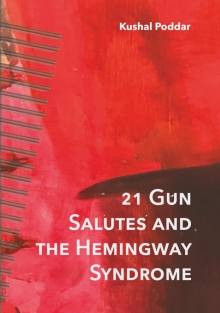
21 Gun Salutes and the Hemingway Syndrome
polytektonSubscribe and get exclusive content and bonus scenes, free books, advanced reader copies and more
About
Poems by Kushal Poddar
In this haunting and lyrical collection, Kushal Poddar invites readers into a world where memory, war, love, and loss converge in surreal and intimate landscapes. Through a kaleidoscope of poetic fragments—each vivid, cinematic, and emotionally resonant—Poddar explores the quiet devastations and fragile beauties of everyday life.
From rain-soaked streets and forgotten train stations to the echoes of family histories and the shadows of conflict, these poems trace the contours of human vulnerability and resilience. With language that is both tender and unflinching, Poddar captures the pulse of a world teetering between chaos and grace.
21 Gun Salutes and the Hemingway Syndrome is a meditation on what it means to live, to remember, and to carry the weight of stories that refuse to fade. It is a book for those who seek poetry that lingers—like a whisper, a wound, or a prayer.
What Other Readers Think
“I have boarded this train / time and again.” With these words, Kushal Poddar begins his intense, rain-soaked flagellation of the soul. A poet of sharp insight — a butcher knife disguised as a stiletto — he proceeds to rip away our illusions. “The sight is only a part of seeing.” It is, indeed, the part that merely partially conceals the dark, underlying realities that only the most daring prospectors of the mind — the mystics, the seers, the psychoanalysts, the poets — dig into. He pierces “the darkness we do not see.”
He struggles to diagnose the disease that calls itself humanity, even while knowing there is no vaccine, no cure, no antidote. “Some doctor switches off / the backlight, we wait / for the deduction and the prescription. / These never come.” But the probing, the scans, the X-rays, the evaluations and prognoses never end. And only the most persistent and hardened of physicians continue to ply their trade. And few of them have the imaginative skills to make their conclusions clear to the rest of the world, those who may feel the pulse and fever of life but cannot connect them to the heartbeat and the infection of existence.
Mankind tries desperately to patent an effective palliative. Any panacea may do. God. Love. Family. Patriotism. Politics. Art. Poddar examines each in its turn, although with characteristic modesty he warns us that “what I say is true / but not enough to be real.”
[...] In the universe of human longing and discontent, perhaps it is only art that has a possibility for redemption. One of the searchers who populate his poems remarks to a poet (perhaps Poddar wishes it was himself) that “we may / sing a song you penned, and it will fit / both the moon and its absence.” This is, indeed, perhaps the only simulation of immortality any of us can hope to enjoy.
Whether art saves us or not, and whether we can even be saved at all, and despite all of Poddar’s doubts and misgivings on this score, he closes with a poignant, wispy image: “We, two sturdy roots of a bygone tree / ... hang fire / for our time to bear leaves, be born again.”
Duane Vorhees, author of Gift, Heaven, Memories Linked
Like Oases, and Between Holocausts, all published by Hog Press