
- Authors
- Alexander Rooksmoor
Alexander Rooksmoor
About
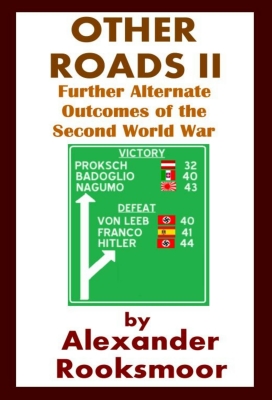
WHAT IF? BOOKS Whilst exploring what did happen in history, I have always been interested, however, in what might have happened differently. This brings me into the other large area of my writing: 'what if?' novels, stories and essays. I feel it is vital to avoid the sense that whatever happened was inevitable. To do that we give up any ability to decide our own futures and the futures of our societies, our countries and our planet. Thus, it is important test the outcomes of history and see if there were different paths that could have been taken. I am always surprised to find that some things people think were essential, turn out not to have been that important and conversely, minor changes in history could have led to very different outcomes. My books about alternate history come in three types. There are full-length fictional novels, occasionally a set of linked novellas. Then there are the collections. The ones with 'what if? stories' in the title are short stories, they are fiction. The books with 'alternate outcomes' in the title are books which analyse alternate paths in history, they are like history books about history that did not happen, rather than being stories. Make sure if you are buying one of my books you get the right type for what you are looking for. 'What if?' history is always highly contested and even writing about different outcomes can lead you to come under attack. People dismiss what you write as being ill-informed, simply 'wrong' or even 'stealing' other people's 'what if?' ideas as if someone can patent speculation on what might have happened. Writing a 'what if?' book can be real fun, but you have to be ready for people to savage you simply on the grounds that they disagree with your particular take on a subject in a way you do not face when writing fiction.
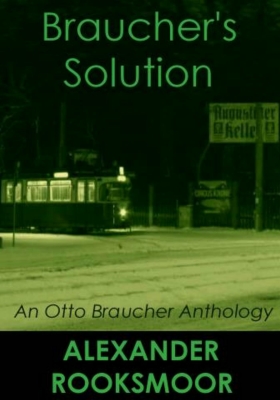
In my collections of 'what if?' essays, I have always been driven by a friend of mine, a keen reader of 'what if?' fiction, that sometimes he cannot engage with a story because he does not know enough about the real history to see what differences the changes make. Thus, I always provide background to allow the reader to drop into the scenario and not feel it is something that they are utterly unfamiliar with. Yet, in line with the principle of my crime fiction, I try to avoiding 'drowning' people in the detail. Then I explore how things could have gone differently. I make no apologies for being challenging in what I write. I love it when readers disagree with me and put a different viewpoint. However, I feel it is unacceptable to tell me that 'no-one wants' that kind of book, let the readers judge for themselves. I also will resist being told that I 'should not write' the history of a particular country. I insist on the freedom to write about any time or place I choose. Everyone should have that right. If people are not interested in what I write, that is fine, but do not seek to censor me. Treat the readers as mature enough to make their own minds up, I do. THE OTTO BRAUCHER SERIES I have been writing for more than two decades now. I have always been interested in history and for much of my adult life have been researching and teaching history. This led me to write a series of crime novels set in 1920s Bavaria. Many people are interested in the Weimar period in German history, 1919-33. It was a period of upheaval that opens up many opportunities for crime stories. Most of the books are novellas set in 1922 and 1923. 'Munich White', however, is a full-length novel set in the summer of 1922 and chronologically preceding the novellas. Drawing on years of reading and teaching about German history this seemed to be a good starting point and so I created Kommissar Otto Braucher. I wanted him to differ from the detectives that I read in so many novels, living alone and with failed relationships. As a veteran of the First World War, Braucher like many men of his generation, has a lot to bear especially trying to enforce the law in the upheaval of 1920s Germany. Yet, he is a man of his time and place, a good Bavarian Catholic with a wife and four children; a keen hiker who enjoys hearty food and is loyal to his friends. This, I feel gives a broader dimension to the character and allows him to engage with a range of developments of the society he is living in. My work has been particularly influenced by the writing of Leonardo Sciascia and Josef Skvorecky. Both men wrote crime novels in which a successful outcome for the detective was not a foregone conclusion. Living in societies in which wealth and influence can disrupt the rule of law, this is a correct portrayal. Thus, in my Braucher stories, despite his skills as a detective, the Kommissar will not always catch the perpetrator and even if he can, he may not be able to bring them to justice. My knowledge of the history allows me to give an authentic context to the fiction and hopefully readers can get a feel for Germany of the time and the pressures it was facing; even the particular crimes that were possible, for example exploiting the hyper-inflation. However, one thing I have learnt as a writer is not to drown the reader in too much detail and accuracy has to be tempered by readability. These books are works of fiction for enjoyment, not lectures for people to gain new knowledge.