
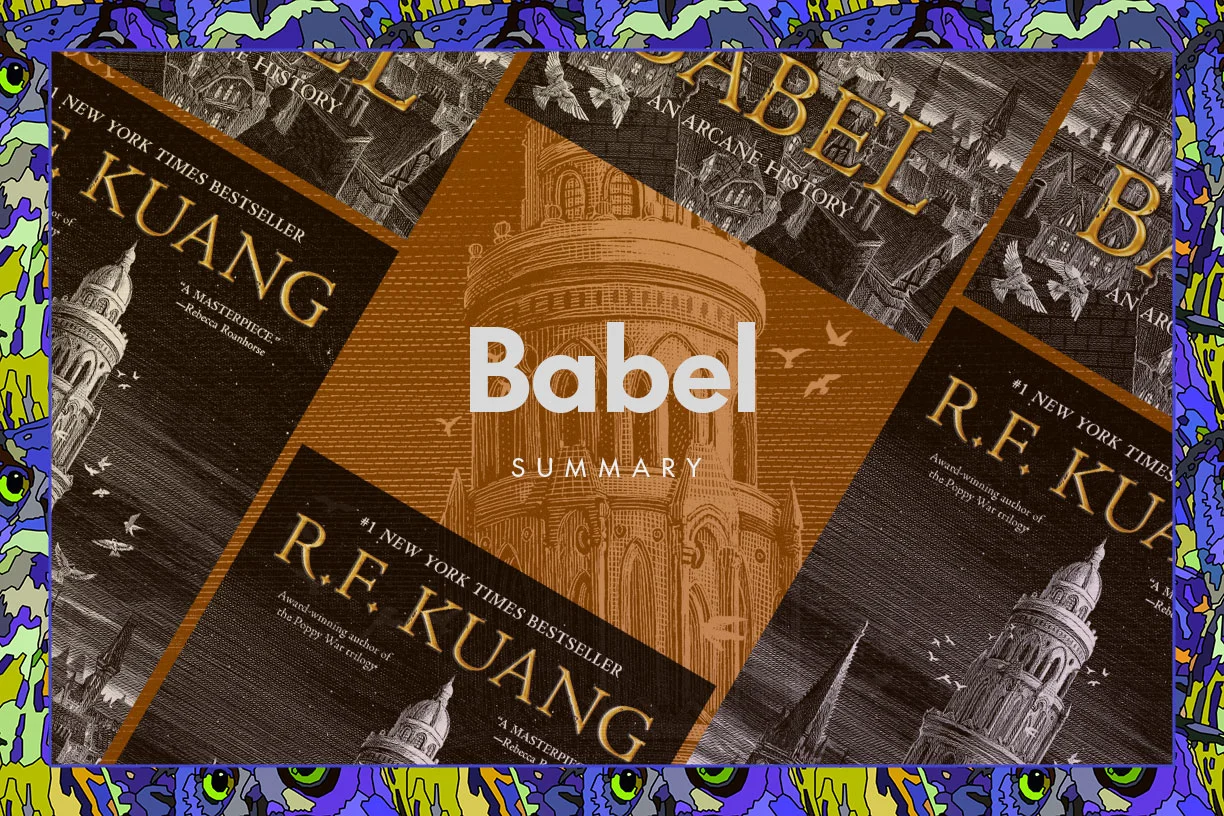
Babel: Or the Necessity of Violence: An Arcane History of the Oxford Translators' Revolution is a dark academia historical fantasy novel by R.F. Kuang, published by Harper Voyager in 2022. After the sweeping success of her debut work The Poppy War trilogy, which we've previously covered in our summary and character breakdown, Kuang delivers another powerful narrative that blends alternate history, linguistic magic, and anti-colonial resistance.
Set in an alternate 19th-century Oxford where translation fuels magical silver-work and upholds British imperial power during the industrial revolution, Babel explores the cost of revolution, the violence embedded in scholarship, and the price of belonging. Kuang’s signature world-building is layered and precise, drawing readers into a morally fraught academic world where language is both weapon and cage.
Already known for her ability to tackle weighty themes with emotional depth, Kuang further expands her literary range in Babel, and again in her satirical contemporary novel Yellowface, which critiques the publishing industry through a different, though equally incisive, lens.
.jpg)
Now let’s dive into the story of Babel itself—fair warning: full spoilers ahead!
Our main character, Robin Swift, is born in Canton. Orphaned by a cholera outbreak and taken to England by the mysterious Professor Richard Lovell. He is raised in isolation and rigorously trained in Latin, Greek, and Chinese, all in preparation for one goal: admission into Oxford University’s Babel Institute, the Royal Institute of Translation, center of magical silver-working, where different languages are used to power enchantments. As he arrives at Babel, Robin is awed by the prestige and wonder of the institute. There, he becomes fast friends with three other students: Ramy from India, Victoire from Haiti, and Letty, an English girl. Though Letty is marginalized for being a woman, she is still white and does not face the deeper alienation the other three experience. Robin, Ramy, and Victoire bond over their shared experiences as racial outsiders, valued for their linguistic talents but never truly accepted.
Early in his time at Babel, Robin unknowingly assists a break-in—a theft of silver bars carried out by his half-brother Griffin whose existence he was not aware of, along with two other members of the secretive Hermes Society. Robin soon learns that Griffin is also Professor Lovell’s son, another child born from his efforts to create perfect multilingual translators. Unlike Robin, Griffin had been taken too early and lacked the linguistic fluency Lovell required, making him a failed experiment in his father’s eyes. Griffin had faked his death, escaped, and joined Hermes, a rebellious society of silver-workers determined to bring down Babel and its exploitation of colonized nations.
After initially helping Griffin, Robin hesitates to fully commit to Hermes. He’s growing comfortable at Oxford, attached to his cohort, and enchanted by the world of academia. But over the years, disillusionment grows. The hypocrisy and cruelty beneath Babel’s polished surface become harder to ignore. Eventually, Robin discovers that Ramy and Victoire have also secretly joined Hermes. A near capture by Babel’s enforcers forces the three friends to admit their involvement to each other, while Letty remains oblivious.
When Professor Lovell uncovers Robin’s connections to Hermes, he confronts him. Though aware of Griffin’s continued existence, Lovell refuses to acknowledge either of them as sons. Robin is given a choice: renounce Hermes and remain at Babel, or be cast out. In a twisted show of authority, Lovell brings Robin, Ramy, Victoire, and Letty on a trip to China under the guise of a diplomatic mission. There, Robin sees the full extent of England’s exploitation; how silver-working enables colonial violence and economic control. Lovell’s indifference to the suffering of the Chinese people and his cold refusal to ever acknowledge Robin as his child culminate in a final rupture. When Robin discovers that Lovell is engineering an opium crisis to justify military action against China—a narrative speaking once again for the opium war. Their confrontation turns deadly. In a moment of rage and grief, Robin kills him.
The others help Robin cover up the murder, and they return to England as fugitives. Hermes helps them escape, but the group’s unity fractures. Letty, unable to grasp the depth of the injustices the others are fighting against, turns on them. Her unrequited love for Ramy and her loyalty to England fuel her act of betrayal. She informs the authorities and leads them to Hermes’ hideout. In the chaos of the raid, Letty shoots and kills Ramy when he refuses to surrender.
Griffin sacrifices himself during the escape, giving Robin and Victoire the chance to flee. Grief-stricken and filled with fury, Robin and Victoire return to Babel—not as students, but as insurgents. They barricade themselves inside, joined by sympathetic students and professors. For weeks, they resist the authorities in a desperate siege. In the end, Robin and the others destroy the source of Babel’s power by blowing up the silver stores, choosing to die within the walls of the institute rather than allow its legacy to continue. Victoire alone survives to carry the memory—and the meaning—of their rebellion forward.
Language in Babel is not just communication—it's literal power. The magic system is built around the gaps between translation, and those who master multiple languages can manipulate the world through silver. But this linguistic power is monopolized by the British Empire to control others, making language both a tool of empowerment and a mechanism of exploitation. Robin, fluent in Mandarin and English, is prized for this reason—but only as a tool.
The novel examines how the British Empire uses institutions like Babel to exploit colonized nations under the guise of intellectual pursuit. Robin and his friends are recruited for their linguistic backgrounds, but their cultures are simultaneously stripped of autonomy. The book explores how imperialism hides behind academia and how even education becomes a form of colonization.
Robin struggles deeply with his sense of identity: caught between two cultures, seen as useful but not equal, and raised to be grateful for a system that dehumanizes him. He tries to belong at Babel and in England, but is never truly accepted. His bond with his cohort—fellow outsiders—is where he first finds belonging. But even that is fragile, especially in the face of betrayal and tragedy.
As Robin’s disillusionment grows, the novel explores the psychological and moral journey toward rebellion. His initial reluctance to act is rooted in comfort and fear, but personal loss, betrayal, and the weight of injustice eventually force him to take a stand. Resistance becomes not just political, but existential—an assertion of his humanity.
Robin’s relationship with Professor Lovell is central to the novel’s emotional core. Lovell is not just a guardian or teacher, but his biological father—one who never shows love or acknowledgment. Robin is both shaped and wounded by Lovell’s rejection. The betrayal by Letty and the death of his chosen family deepen this theme. Ultimately, Robin chooses to reject the legacy Babel offers him.
Robin’s final act—choosing to die inside Babel in order to destroy it—is a powerful expression of sacrifice. Throughout the novel, characters like Griffin, Ramy, and Robin are asked to give everything for the hope of change. The story asks what resistance truly costs—and whether such a cost is worth paying.
Babel is an amazing read, with a unique magic system, a compelling storyline, and impressive character development. A definite standout in fantasy books, this story does not disappoint, and we strongly recommend it!
And if you want to receive news about the hottest new releases and everything bookish, make sure to subscribe to crewfiction and register for our Tea & Cakes newsletter!
It can be. With its slow progression and deep dive into etymology, accompanied by footnotes to give off an academic vibe, Babel can definitely be a somewhat difficult read for some, but we guarantee it is worth it.
While not a romance book, Babel’s deep character complexity involves feelings toward one another, with a “heavily implied” romance between our main character, Robin, and Ramy.
The main idea of Babel is that language is power, and in the hands of the empire, that power is exploitative and violent. In the story, language and translation are used as tools of imperial power, showing that academia and knowledge can be complicit in exploitation and colonization.

