
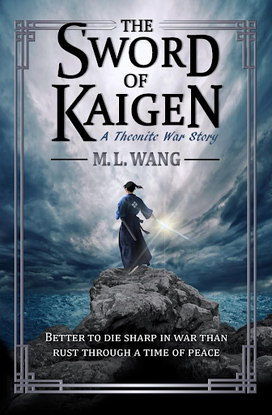
M.L. Wang’s The Sword of Kaigen is one of the most celebrated self-published fantasy novels of recent years, winning the Self-Published Fantasy Blog-Off (SPFBO) 2019–2020. Often recommended alongside R.F. Kuang’s The Poppy War trilogy for readers seeking adult fantasy rooted in war, trauma, and the cost of survival, it also shares similarities with Avatar: The Last Airbender through its elemental magic system, martial arts-inspired fighting, and devastating emotional arcs—much like the Jade City trilogy as well.
If you’re exploring Wang’s work further, check out our Blood Over Bright Haven summary, another standalone with razor-sharp politics and world-building. And if military strategy, imperial propaganda, and character-driven war stories are your thing, dive into our coverage of Kuang’s acclaimed Poppy War series through our summary and character analysis!
Now, without further ado, let’s move on to summary, but beware, major spoilers ahead!
At its core, The Sword of Kaigen is a character-driven high fantasy book that blends the intimacy of family life with the sweeping scale of an imperial war story. It’s about a warrior family in a snowy mountain village in Japan-inspired Kaigen, where tradition binds tightly and loyalty to the Empire comes at the cost of truth. Told through alternating POVs between a mother and her son, the novel delivers both intimate emotion and large-scale devastation.
Set in the village of Takayubi on the Kusanagi Peninsula—known as the “Sword of Kaigen”—this remote stronghold is the Empire’s first line of defense. For generations, the Matsuda clan has carried on the tradition of martial discipline and the Whispering Blade, a pinnacle technique of their water- and ice-based elemental magic. Not every Matsuda achieves it, but those who do are revered as the highest defenders of the Empire.
The Theonite world revolves around bloodline magic. Misaki, the family matriarch, carries a feared and secret inheritance: blood magic. She passes it on to her son Mamoru, though he is forbidden from using it, as it would mark him as “impure” in the eyes of the proud Matsuda. In a society where bloodlines determine worth, secrecy is survival.
The story follows fourteen-year-old Mamoru Matsuda, whose daily climb of 821 steps to Kumono Academy is both a physical challenge and a metaphor for his resolve. His friends Itsuki and Yuuta can hardly keep up, but Mamoru is determined to prove himself. Along the way, he meets Kwang Chul-hee, a transfer student from the north. With his modern uniform, heavy accent, and outsider status, Kwang openly questions the propaganda taught in school. His bold claims about the Empire’s lies unsettle Mamoru, and when the two stumble upon a crashed Yammanka plane made of rare Zilazen glass, the illusion shatters. The Empire has deceived its people, using Takayubi’s proud warrior families as expendable cannon fodder.
Meanwhile, Mamoru’s mother, Misaki, lives outwardly as a dutiful housewife, but her inner world is shaped by a life she left behind. Through flashbacks, readers discover her time abroad in Carytha, where she trained at an international theonite academy, sparred alongside women like Robin and Elleen, and experienced love, loss, and freedom. These glimpses of her past contrast sharply with the rigid constraints of Kaigen. Even with the comfort of her sister-in-law, Setsuko, and their friend Hyori, Misaki conceals her full truth—her bloodline magic, her desires, her grief over miscarriages—living in silence within her cold marriage.
Her husband, Takeru, embodies the Matsuda ideal: distant, stoic, and unyielding. When Mamoru begins questioning the Empire and defies his father, Takeru responds with violence. Misaki, however, secretly steps in to protect and train her son, nurturing him in a way her husband never could.
When the Ranganese Union invades, the mountain stronghold collapses. Explosive battle sequences erupt as soldiers storm Takayubi, and Misaki unleashes the full extent of the power she has long suppressed. Her fight scenes—infused with Japanese martial culture and elemental mastery—are breathtaking. Mamoru, determined to defend his people, enters a brutal duel against a skilled soldier and sacrifices himself. His sword, later named Mamoriken (“Protector”), becomes a lasting symbol of his bravery.
The aftermath is devastating. Takayubi is razed, families shattered. Misaki, broken by grief, faces the silence of a husband she has never truly known. In a climactic duel between wife and husband, Takeru finally breaks down, confessing that his stoicism was cowardice—that he closed his heart out of fear. For the first time, they see each other honestly, reconciling in shared vulnerability. Misaki learns that even though she once longed for the freedom of her past, her family in Kaigen is enough. With Robin Thundyil’s return and the companionship of Setsuko and her children, Hyori and Setsuko, Misaki begins piecing together a fragile but hopeful future.
M.L. Wang’s The Sword of Kaigen shines because it is not only about war but also about complex characters, alternating POVs, layered character arcs, and the bonds of family. From its careful world-building and magic glossary (handy in the Kindle edition and audiobook) to its devastating emotional resonance, the novel remains one of the most beloved entries on any fantasy TBR list.
Tradition vs. Change
The tension between rigid samurai-like discipline and the need for individuality is central, especially in Mamoru’s relationship with his father, Takeru.
The Cost of War
A war story at heart, the book highlights not only the spectacle of battle but also the emotional wreckage it leaves behind.
Identity, Secrecy, and Bloodlines
Bloodline powers are a source of pride and shame alike. Misaki conceals her blood magic, Mamoru is forbidden to use his, and both suffer under the weight of silence. The novel interrogates what it means to carry an inheritance you cannot fully claim.
Propaganda and Power
The Empire’s narrative of Kaigen as its “strongest sword” hides a darker truth: that Takayubi’s people are used as disposable cannon fodder. Indoctrination runs deep, and breaking free of it demands painful confrontation with the truth.
Marriage and Reconciliation
Rarely does fantasy center on the complexities of marriage. Misaki and Takeru’s cold, distant relationship transforms into a fragile but powerful bond forged through grief, honesty, and mutual recognition.
Family and Sacrifice
The heart of the novel lies in its exploration of family ties, grief, and what it means to protect the ones you love—even at unbearable cost.
Japanese Influence
From the snowy mountain village setting to the samurai-inspired discipline, the story is deeply infused with Japanese culture while reimagining it in a high fantasy context.
If The Sword of Kaigen left you breathless with its action scenes, character development, and world-building, you’re not alone—it’s a book that stays with readers long after the final page.
To keep exploring fantasy books like this, join us at crewfiction and sign up for our Tea & Cakes Newsletter. You’ll get book discussions, character deep dives, and cozy recommendations delivered right to your inbox!
The story centers on the Matsuda family: Mamoru, a young warrior-in-training; his mother, Misaki, whose hidden past and bloodline magic shape the heart of the novel; his father, Takeru, the stoic patriarch; and siblings Setsuko and Hyori. Other key figures include Kwang Chul-hee, the transfer student who exposes the Empire’s lies, and Robin Thundyil, Misaki’s old friend from her days abroad.
Not at all. While the novel shares a universe with M.L. Wang’s Theonite series, The Sword of Kaigen works perfectly as a standalone fantasy book. You can enjoy it on its own.
Romance is not the focus, but Misaki’s backstory and her cold, arranged marriage to Takeru provide some of the most compelling emotional arcs. Their relationship evolves from duty and distance into reconciliation, as grief forces them to confront hidden truths and rediscover each other.

